Earnings Upside Accelerates Amid Booming Memory Super Cycle



Biwin Storage delivered explosive earnings growth in the first quarter of 2026, fully benefiting from the industry-wide memory super cycle driven by AI infrastructure expansion. The company released its Q1 2026 financial report on April 15, posting operating revenue of RMB 6.81 billion, surging 341.53% year-over-year. Net profit attributable to parent shareholders reached RMB 2.90 billion, representing a dramatic 1,568% year-over-year increase and a 252.41% quarter-over-quarter improvement. Gross margin expanded sharply to 53.30%, up 51.32 percentage points year-over-year and 21.39 percentage points quarter-over-quarter, while net margin climbed to 42.22%, reflecting year-over-year and quarter-over-quarter increases of 55.54 and 24.51 percentage points respectively, marking a substantial upgrade in overall profitability.
Inventory Flexibility and Product Price Hikes Drive Cyclical Profit Surge
Biwin’s extraordinary Q1 earnings and margin expansion stem from robust industry prosperity and continuous product price increases fueled by skyrocketing AI computing demand. To capitalize on tightening market supply, the company proactively built strategic inventory reserves, with total inventory balance reaching RMB 12.07 billion at the end of Q1 2026, up 53.39% from end-2025.
During the first quarter, Biwin secured a long-term operational procurement contract worth USD 1.5 billion with a leading memory manufacturer. Spanning eight consecutive quarters from Q2 2026 to Q1 2028, the deal adopts fixed unit pricing with evenly scheduled quarterly purchases. The long-term lock-in strategy stabilizes mid-to-long-term wafer supply chains, mitigates cost volatility from cyclic memory price fluctuations, and validates the company’s robust upstream sourcing capabilities.
Looking ahead, industry research firm TrendForce projects memory prices will maintain upward momentum in Q2 2026. The company’s inventory cost level at end-Q1 remains significantly lower than current market selling prices, ensuring smooth price transmission and sustainable profitability improvement. Biwin is well-positioned to sustain strong earnings performance throughout Q2 and full-year 2026.
Booming AI Edge Deployment Drives Rapid Growth in Wearable Memory Business
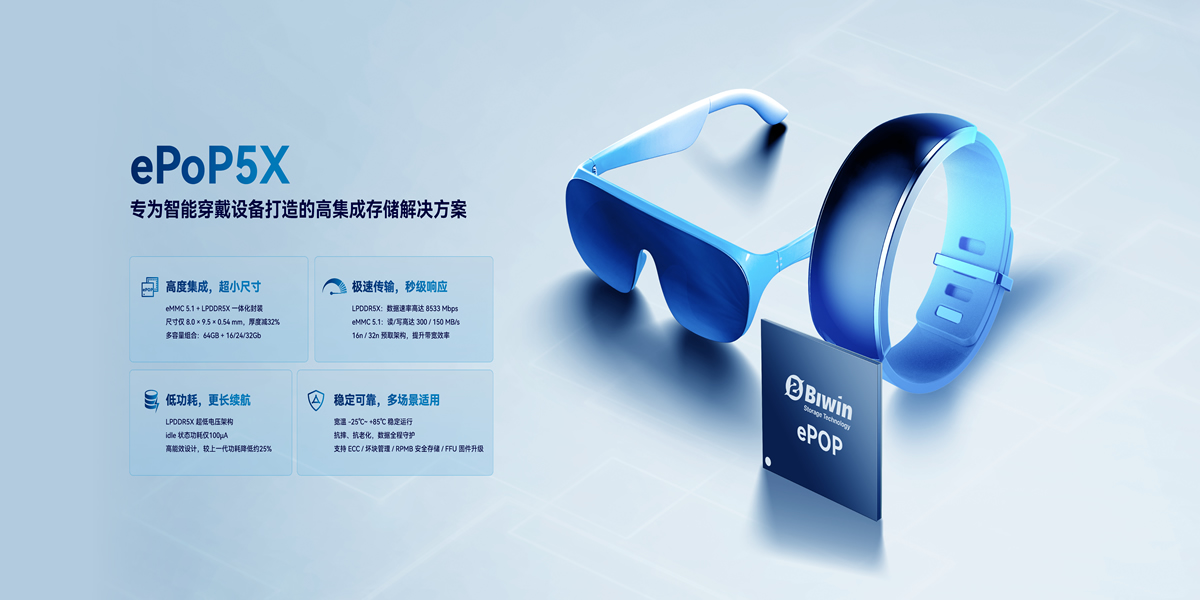
AI edge applications have emerged as a powerful new growth driver for Biwin’s product portfolio. The company’s new-generation AI edge memory products generated revenue of RMB 1.18 billion in Q1 2026, skyrocketing 496.45% year-over-year and rising 53.19% quarter-over-quarter. Leveraging inherent advantages in low power consumption, fast response and ultra-compact form factors, Biwin’s flagship ePOP and wearable memory solutions have been widely adopted by global tier-one clients including Meta, Google, Alibaba, Xiaomi, Imoo and Rokid for AI/AR glasses, smartwatches and other wearable devices.
As AI wearable hardware enters large-scale commercialization, Biwin continues to deepen strategic cooperation with key customers such as Meta. The company’s early penetration in high-growth AI edge scenarios establishes solid first-mover advantages, positioning it to capture incremental market share amid the expanding AI edge ecosystem.
Breakthroughs in In-House Controller Chips and Advanced Packaging Capacity Expansion
Biwin continues to ramp up R&D investment to strengthen core technological self-reliance, with Q1 2026 R&D expenditure rising 26.78% year-over-year. The company focuses resources on chip design, firmware optimization, new product iteration and advanced packaging and testing capabilities.
In terms of self-developed controller chips, Biwin’s first in-house eMMC controller model SP1800 has achieved mass production and steady customer shipment, delivering outstanding low-power performance tailored for wearable devices. The company expects total annual shipment of self-developed controllers to exceed 25 million units in 2026. Meanwhile, the in-house UFS 3.1 controller project has taped out in February 2026 and is scheduled for client validation and mass deployment in the second half of the year, further strengthening Biwin’s competitiveness in AI smartphones, wearables and intelligent vehicle storage markets.
The company’s advanced wafer-level packaging and testing project in Songshan Lake, Dongguan, progresses steadily with ongoing customer sampling and verification. Pending smooth client qualification, the project is expected to commence revenue contribution by the end of 2026. The integrated service model combining storage chip supply and advanced packaging enables Biwin to provide one-stop system-level solutions, reinforcing its technological moat and market competitiveness in computing-storage integration scenarios.




All Rights By Glebors Media © 2026